
Laminate vs. Engineered Wood Flooring in Denver: The Complete Guide for Colorado Homeowners
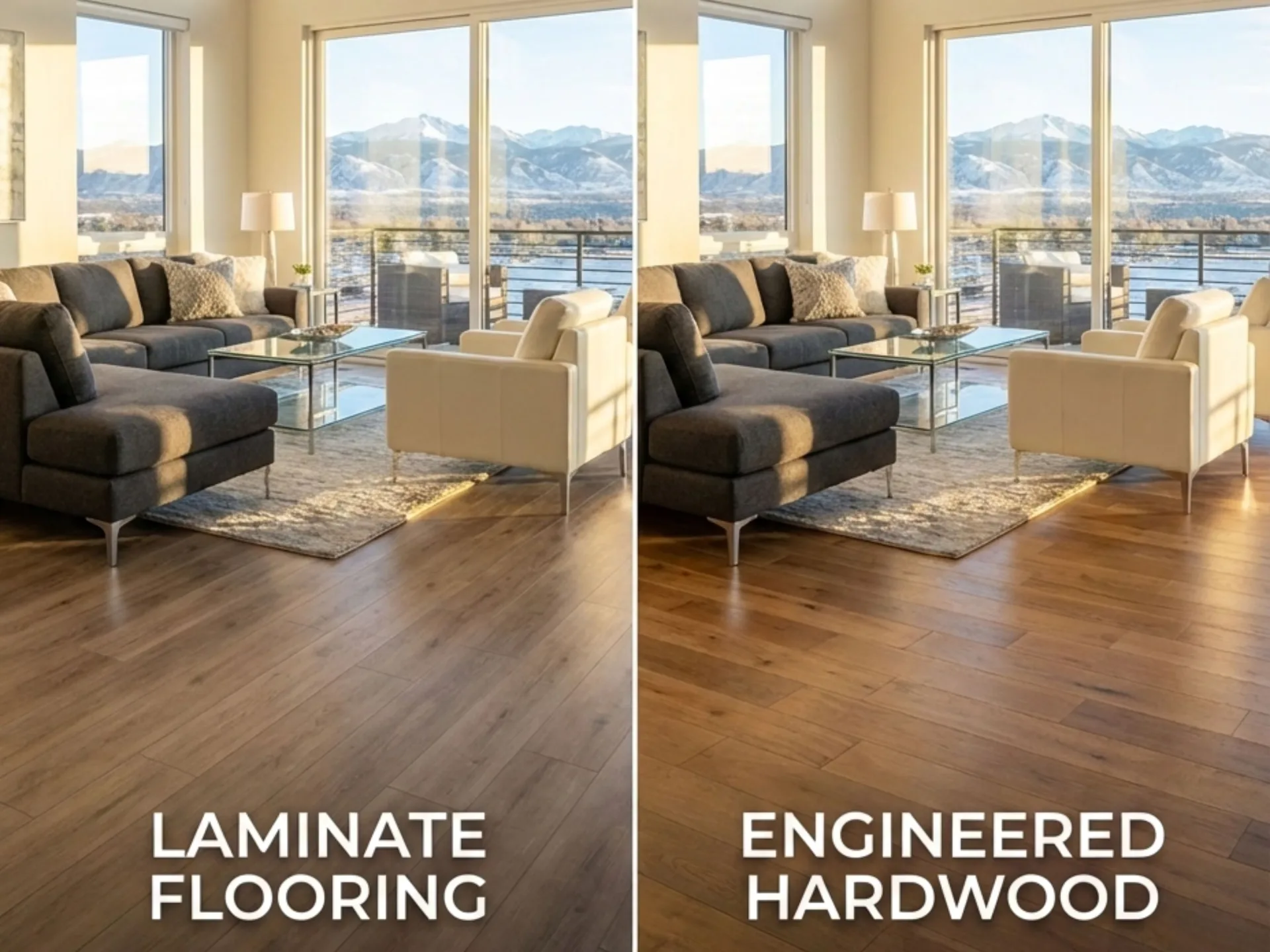
You’re standing in a flooring showroom in Cherry Creek, overwhelmed by options. The salesperson keeps using terms like “laminate” and “engineered wood,” but here’s what they’re not telling you: Denver’s extreme climate—with winter humidity levels plummeting to 15% and altitude-driven UV exposure—can make or break your flooring investment.
Make the wrong choice, and you’ll face gapping planks by December, a faded finish by summer, and a $15,000 mistake that looks dated before you’ve finished unpacking. Colorado’s 5,280-foot elevation isn’t just a bumper sticker—it’s a brutal testing ground for flooring materials that weren’t designed with the Rocky Mountain climate in mind.
This guide breaks down exactly how laminate and engineered wood perform in Denver’s unique conditions, so you can choose flooring that will still look stunning when you’re hosting holiday parties in Castle Rock or showing off your Highlands Ranch renovation.
What is Laminate Flooring?
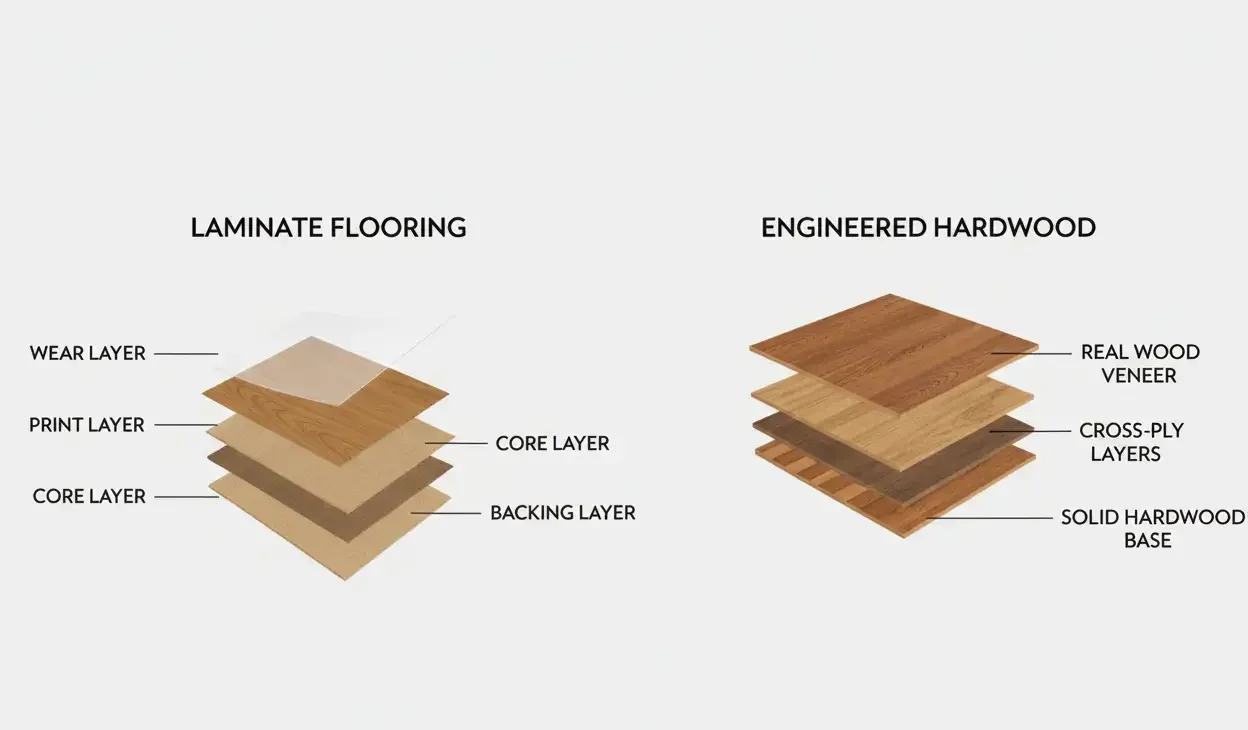
Laminate flooring consists of a high-resolution photographic image of wood protected by a clear wear layer, all bonded to a high-density fibreboard core. Think of it as a sophisticated, durable “picture” of wood that’s designed to resist scratches and stains.
How it’s constructed (from top to bottom):
- Wear layer: Clear protective coating rated AC1-AC5 (higher = more durable)
- Design layer: High-resolution wood image
- Core layer: HDF (high-density fiberboard)
- Backing layer: Moisture barrier and stability
Denver-specific consideration: The fibreboard core is vulnerable to moisture damage—critical during Colorado’s unpredictable spring snowmelt and surprise storms that leave slush tracked through entryways.
Typical lifespan in Denver: 10-15 years with proper maintenance
Pros and Cons of Laminate
Advantages:
- Scratch and stain resistant – AC4-AC5 rated laminate withstands pet claws and spills better than wood (ideal for active Denver families)
- Budget-friendly – 40-50% less expensive than engineered wood upfront
- Moisture resistant – a better choice for basements prone to Colorado’s seasonal moisture issues
- Fade-resistant – Photographic layer maintains color consistency even in high-UV Denver sunlight
- Easy DIY installation – Click-lock systems allow homeowner installation (saves $2-4/sq ft labor)
- Minimal maintenance – No refinishing required; simple sweep and damp mop
Disadvantages:
- Cannot be refinished – Once damaged or worn, entire planks must be replaced; no restoration option
- Zero resale value boost – Appraisers consider it “builder-grade” in Denver’s premium markets
- Hollow feel underfoot – Less comfortable than wood; creates an echoing sound when walking
- Shorter lifespan – 10-15 years maximum versus 30-50 years for engineered wood
- Fiberboard core is vulnerable to moisture . Severe water damage (burst pipes, flooding) often requires complete replacement
- Less authentic appearance – Even premium laminate doesn’t replicate wood’s natural texture and grain variation
Can I Use Laminate Everywhere in the House?
Yes, laminate is the most versatile flooring option—but you’ll sacrifice resale value in premium areas.
Excellent Choices:
- Basements – Ideal for Colorado basement moisture concerns; install with vapor barrier underlayment
- Rental properties – Durability and low cost offset the lack of resale premium
- Kids’ rooms and playrooms – Scratch-resistant handles, toys, and active play
- Laundry rooms – Moisture-resistant if properly sealed at seams
- Home gyms – Withstands dropped weights better than wood
Acceptable (with caveats):
- Main living areas – Functionally fine, but Denver buyers in $600K+ homes expect real hardwood
- Kitchens – Performs well if spills are cleaned promptly; choose waterproof laminate for added protection
- Entryways – High traffic rated (AC5) required; still won’t refinish like engineered wood when wear appears
The Resale Reality:
In Denver’s competitive real estate market, laminate throughout a $575,000 Highlands Ranch home signals “budget renovation” to buyers and appraisers. Strategic approach: Use engineered wood in visible main floor living spaces (living room, dining room, kitchen) and laminate in bedrooms/basement to balance cost with resale appeal.
What is Engineered Hardwood Flooring?
Engineered hardwood features a real wood veneer (typically 2-6 mm thick) bonded to multiple layers of plywood or high-density fibreboard arranged in a cross-grain pattern. This construction provides dimensional stability that solid hardwood cannot match.
How it’s constructed (from top to bottom):
- Wear layer: Real hardwood veneer (oak, maple, walnut, hickory, etc.)
- Core layers: 5-9 layers of plywood or HDF in alternating grain directions
- Backing layer: Stabilizing veneer
Why Denver contractors recommend it: The cross-ply construction prevents the cupping and crowning that solid hardwood experiences in Colorado’s extreme humidity swings (15% in winter to 45% in summer).
Key advantage: Can be professionally refinished 1-3 times, depending on veneer thickness, extending lifespan to 30-50 years.
Pros and Cons of Engineered Wood
Advantages:
- Authentic hardwood appearance and feel – Real wood veneer provides warmth that laminate cannot replicate, especially important during Colorado’s cold winters
- Can be refinished – Our dustless refinishing process restores 15-year-old floors to showroom condition in 2-3 days for $3-5/sq ft versus $8-12/sq ft for replacement
- Increases home value – Adds 3-5% to appraisal value in Denver’s $500K+ market (Cherry Hills Village, Greenwood Village, Castle Rock)
- Better acoustic properties – Natural wood absorbs sound versus laminate’s hollow echo in open-concept Denver floor plans
- Dimensional stability in Colorado climate – Cross-ply construction handles humidity swings better than solid hardwood
- Environmentally friendly – Can last 30-50 years with refinishing; biodegradable at end of life
Disadvantages:
- Higher upfront cost – Nearly double the initial investment compared to laminate
- UV fading – Natural wood veneer will patina over time in south-facing rooms (common in Denver architecture); requires UV-resistant finishes
- Scratches more easily than laminate – While dents can be sanded out during refinishing, laminate’s wear layer is more scratch-resistant daily
- Requires climate acclimation – Must acclimate 7-10 days in Denver homes with proper humidity levels (35-45% RH)
- Limited refinishing cycles – Thinner veneers (2-3mm) may only allow 1-2 refinishing cycles, versus unlimited with solid hardwood
Can I Use Engineered Wood Everywhere in the House?
Yes, with important Denver-specific exceptions and modifications:
Ideal Locations:
- Main living areas – Living rooms, dining rooms, hallways (where aesthetics and resale value matter most)
- Bedrooms – Comfortable underfoot; adds warmth during Colorado winters
- Home offices – Professional appearance for video calls; superior acoustics versus laminate
- Upper floors – Better noise reduction for multi-story homes, common in Highlands Ranch
Proceed with Caution:
- Kitchens – Acceptable IF you’re vigilant about spill cleanup, consider water-resistant engineered wood with sealed seams
- Entryways – High traffic + snow/slush tracked from Colorado winters = accelerated wear; choose harder wood species (hickory, maple) with durable finishes
Not Recommended:
- Basements below grade – Denver’s occasional spring flooding and concrete slab moisture make laminate or LVP safer choices
- Laundry rooms – High moisture risk from appliances
- Full bathrooms – Standing water from showers/tubs will damage even water-resistant engineered wood
Denver contractor tip: In premium homes (Cherry Hills Village, Castle Rock), we often recommend engineered wood throughout main living spaces with strategic LVP in moisture-prone zones—maintaining high-end aesthetic while protecting your investment.
Which is Better, Laminate or Engineered Wood Flooring?
The honest answer: It depends on your specific situation, budget, and timeline. Here’s a side-by-side comparison for Denver homeowners:
Head-to-Head Comparison
| Factor | Laminate Flooring | Engineered Wood | Winner for Denver |
|---|---|---|---|
| Upfront Cost (2,000 sq ft) | $10,000-$22,000 | $18,000-$38,000 | Laminate |
| Lifespan | 10-15 years | 30-50 years (with refinishing) | Engineered Wood |
| Refinishing Capability | Cannot refinish | 1-3 times (depends on veneer thickness) | Engineered Wood |
| Scratch Resistance | Excellent (AC4-AC5 wear layer) | Moderate (can be sanded during refinishing) | Laminate |
| Colorado Humidity Tolerance | Excellent (minimal expansion/contraction) | Good (requires 35-45% RH maintenance) | Laminate |
| UV Fade Resistance | Excellent (photographic layer stable) | Moderate (natural patina develops) | Laminate |
| Resale Value Impact | Neutral ($0 added value) | +3-5% home value ($15K-$25K on $500K home) | Engineered Wood |
| Moisture Resistance | Good (but fiberboard core vulnerable to flooding) | Moderate (avoid basements/bathrooms) | Laminate |
| Authenticity & Feel | Synthetic (hollow sound underfoot) | Real wood (warm, natural acoustics) | Engineered Wood |
| DIY Installation | Easy (click-lock system) | Moderate to difficult | Laminate |
| Best for Denver Basements | Yes (with vapor barrier) | Not recommended | Laminate |
| Best for Main Living Areas ($600K+ homes) | Acceptable but limits resale | Preferred by buyers & appraisers | Engineered Wood |
| Pet & Family Durability | Excellent daily durability | Good (damage can be refinished out) | Laminate (short-term) / Engineered Wood (long-term) |
| Environmental Impact | Non-renewable; landfill after 15 years | Sustainable; biodegradable; 50-year lifespan | Engineered Wood |
Quick Decision Guide
Choose LAMINATE if:
- Budget is under $15,000 for 2,000 sq ft
- High-traffic rental property or basement installation
- You have large dogs and prioritize daily scratch resistance
- Selling within 3-5 years and want a cost-effective update
- Moisture-prone areas or below-grade installation
Choose ENGINEERED WOOD if:
- Home value exceeds $500,000 (Cherry Hills Village, Castle Rock, Highlands Ranch)
- Planning 10+ year occupancy with desire to refinish
- Main living areas where aesthetics and resale value matter
- You want authentic wood warmth during Colorado winters
- Maximum resale value is a priority in the competitive Denver market
Real Denver Data: Homes in premium Denver suburbs with engineered hardwood sell 18% faster than comparable properties with laminate (per Denver Metro Association of Realtors).
Refinishing Capability: The Game-Changer
Laminate: Once damaged, entire planks must be replaced. No refinishing possible.
Engineered wood: Can be professionally refinished 1-3 times, depending on veneer thickness. Our dustless refinishing process (exclusive in the Denver market) allows you to restore 15-year-old floors to showroom condition in 2-3 days—without evacuating your home.
Cost analysis:
- Laminate replacement: $8-12/sq ft installed
- Engineered wood refinishing: $3-5/sq ft for complete restoration
Denver Climate Factors: What Really Matters
Denver’s high-altitude location (5,280 feet) creates unique flooring challenges that don’t exist in other markets. Here’s how each season impacts your flooring choice:
Seasonal Impact Comparison
| Season | Climate Challenge | Laminate Performance | Engineered Wood Performance | Homeowner Action Required |
|---|---|---|---|---|
| Winter (Dec-Feb) | Humidity drops to 15-20% RH Indoor/outdoor temp swings of 40-50°F |
Minimal movement Maintains stability Slight seam visibility as coating contracts |
2-3% contraction possible Gapping if humidity is not controlled Cross-ply prevents cupping |
Laminate: Monitor seams in high-traffic areas Engineered Wood: Run whole-home humidifier; maintain 35-45% RH |
| Spring (Mar-May) | Unpredictable snowstorms Rapid snowmelt Moisture tracked indoors |
Moisture-resistant surface The fiberboard core is vulnerable if water sits |
Water damage is possible at seams Avoid near entryways without mats |
Both: Use commercial-grade entry mats Clean spills immediately Remove wet boots promptly |
| Summer (Jun-Aug) | UV exposure 35% higher than sea level Humidity rises to 40-45% RH Monsoon season moisture |
Excellent fade resistance Color stability Slight expansion (not problematic) |
Natural patina develops in 18-24 months Expansion in high-humidity periods Proper installation gaps prevent buckling |
Laminate: No action needed Engineered Wood: Use UV-resistant finishes; area rugs on south-facing floors |
| Fall (Sep-Nov) | Humidity drops rapidly Heating systems activate Dry air returns |
Returns to winter stability Minimal adjustment needed |
Rapid contraction as humidity drops Clicking sounds possible if the gaps are inadequate |
Laminate: No action needed Engineered Wood: Restart humidification early (mid-October) |
The Dustless Refinishing Advantage: Why It Matters for Denver Homes
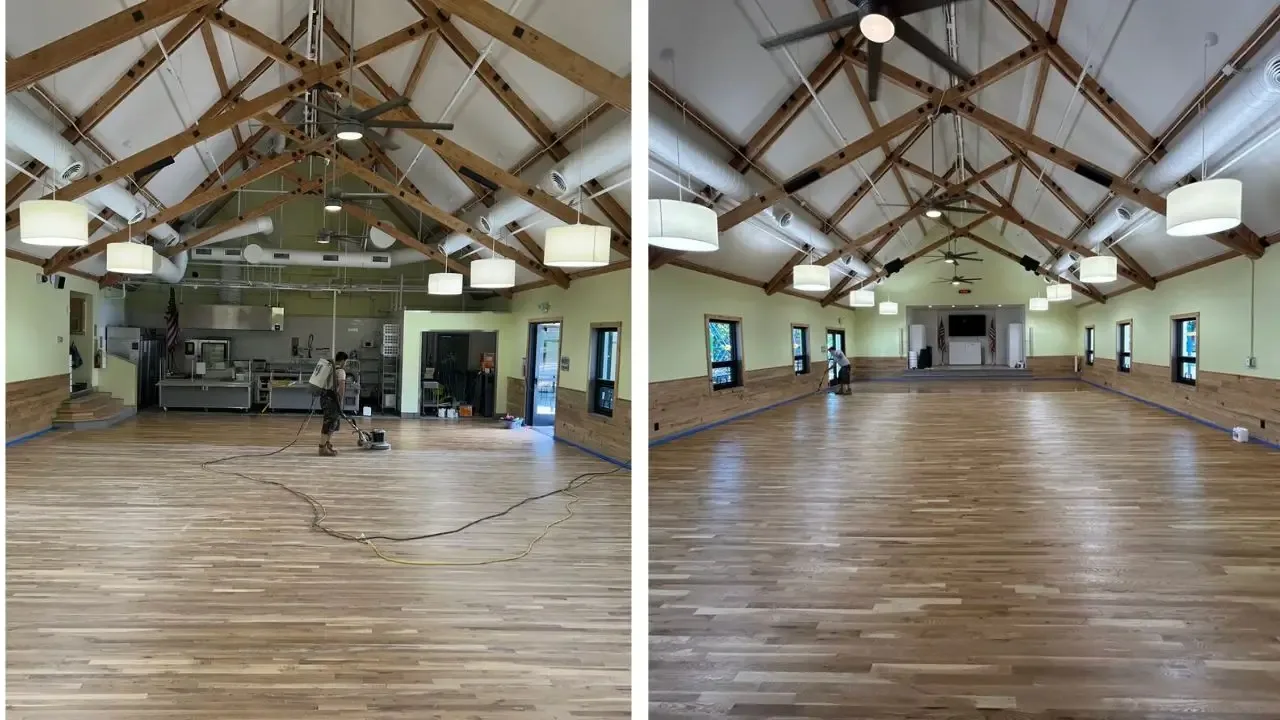
Traditional floor sanding creates 2-3 pounds of airborne dust per 100 square feet. In Denver’s dry climate with limited ventilation during the winter months, that dust infiltrates:
- HVAC systems (reducing efficiency by up to 30%)
- Electronics and appliances
- Respiratory systems (particularly problematic at altitude)
Our dustless system:
- 99.8% dust containment via HEPA filtration
- Allows furniture to remain in adjacent rooms
- Work continues during Colorado winters without opening windows
- No need to relocate family or pets
Timeline comparison:
- Traditional sanding: 5-7 days + 2 weeks for dust cleanup
- Dustless refinishing: 2-3 days, move back in immediately
Frequently Asked Questions
Q: Can engineered wood handle Colorado’s dry winters?
Yes, IF properly installed with adequate expansion gaps (⅜-½” in Denver vs. standard ¼”) and whole-home humidification maintaining 35-45% RH.
Q: Will laminate look cheap in my Greenwood Village home?
Premium laminate (AC5, 12mm thick) can fool visitors, but realtors and appraisers identify it immediately. In homes over $600K, engineered wood adds $15,000-25,000 more value than laminate costs.
Q: How long before I need to refinish engineered wood?
Typically 10-15 years, depending on traffic and maintenance. Our dustless process restores floors to their original condition in 2-3 days.
Get Your Free Flooring Consultation
Not sure which option is right for your Denver home?
We’ll bring laminate and engineered wood samples to you, show you real costs (not just upfront pricing), and assess whether existing floors can be refinished instead of replaced.
20+ years serving Denver metro | 65+ Five-Star Reviews | Dustless Refinishing Specialists