How to Fix a Gouge in a Hardwood Floor
That sinking feeling when you slide the couch back and spot a fresh gouge in your hardwood floor? We get it. The good news: most gouges are far more fixable than they look, and you almost never need to refinish the entire floor to make one disappear.
This guide walks you through exactly how to fix a gouge in a hardwood floor—from a light surface mark to a deep, splintered one—using the same methods our crews use on Denver floors every week. You’ll learn which repair matches your damage, what it costs, and when a gouge is worth handing to a pro.
How to Identify the Type of Gouge in Your Hardwood Floor
Identify the gouge type by its depth, because depth—not width—determines the correct repair. Run a fingernail across the damage in daylight, then match it to the table below.
| Gouge Type | Description | Best Repair Method | DIY Difficulty |
| Surface | Affects only the finish layer | Wax or touch-up marker | Very Easy |
| Shallow | Penetrates finish into wood but < 1/8″ deep | Wood filler or wax stick | Easy |
| Deep | Extends >1/8″ into wood | Epoxy wood putty | Moderate |
| Structural | Damages the integrity of the board | Board replacement | Difficult |
Denver tip: Our dry, high-altitude air makes wood shrink slightly, which can make a gouge look deeper than it really is. Measure the actual depth in daylight before deciding on a method.
If you’re dealing with widespread damage rather than a single mark, our hardwood floor repair services can assess the full picture before you pick a method.
How to Fix a Shallow Gouge in a Hardwood Floor
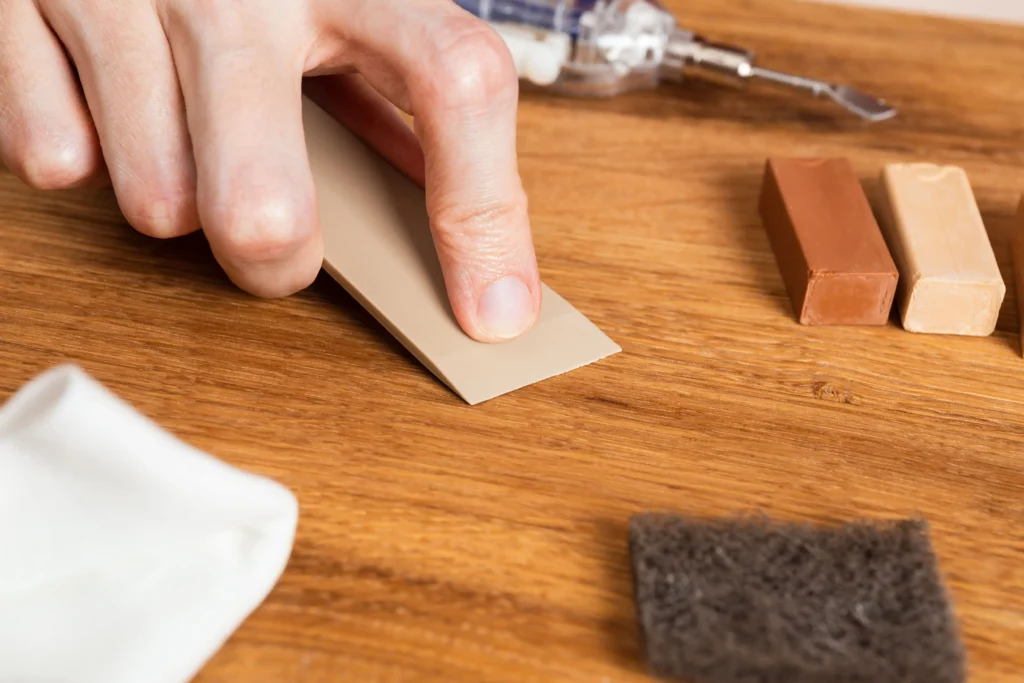
For surface and shallow gouges—the kind you feel with a fingernail but that don’t reach far into the wood—a wax stick is your fastest, cleanest fix. No sanding, no drying overnight.
Wax Stick / Touch-Up Marker Method
- Choose a wax stick that closely matches your floor color. Blending two shades often gives a better match than a single stick.
- Rub the wax firmly into the gouge, slightly overfilling it.
- Scrape the excess level with a plastic card or putty knife.
- Buff gently with a soft cloth until the repair blends in.
Pros: Fast, cheap, no sanding, beginner-friendly.
Cons: Not durable in high-traffic areas; won’t hold in gouges deeper than 1/8 inch.
Denver’s bright, shifting daylight changes how colors read. Check your match in both morning and afternoon light before you call it done—what blends at noon can stand out at dusk. Choosing the right boards from the start helps too—these are Colorado’s most scratch-resistant hardwood floors for high-traffic homes.
How to Fix a Deep Gouge in a Hardwood Floor
Fix a deep gouge (over 1/8 inch) with two-part epoxy or premium color-matched wood filler, following these steps:
- Pack the filler or mixed epoxy firmly into the gouge, slightly overfilled.
- Let it cure completely—often faster than the label states in Denver’s low humidity.
- Sand flush with 220-grit sandpaper.
- Apply a matching stain, then two thin coats of polyurethane.
Wood filler vs. epoxy: Which should you use?
- Wood filler: Easier to apply, ideal for moderate depth. Can shrink or pop out over the years of foot traffic.
- Two-part epoxy: Bonds harder, resists shrinking through freeze-thaw swings, and accepts stain. Slightly more effort to mix and color-match.
For gouges where wood is actually missing, epoxy is the more durable choice in our experience with Colorado’s temperature extremes. For damage that spans several boards or mixes gouges, dents, and scratches, hardwood floor resurfacing restores the surface without a full sand-down.
How to Fix Gouges Without Refinishing or Replacing Boards
Yes—spot repair fixes a single gouge without sanding or refinishing the surrounding floor, and it’s the right approach for isolated damage.
Wax, filler, and epoxy are all designed for localized repair. The technique that makes it invisible is feathering: keeping filler and finish tight to the gouge so no halo forms around it.
Full refinishing is only cost-justified when gouges and wear are spread across an entire room—not for one or two marks. If gouges are scattered across the whole room, full hardwood floor refinishing may actually be the more cost-effective route.
For a deeper look at spot-fixing techniques, see our specialist guide on how to repair wood floors without sanding in Colorado’s dry climate.
What’s the difference between a gouge and a dent—and how do you fix each?
A gouge removes wood and must be filled, while a dent only compresses wood fibers and can often be raised with heat and moisture—no filler needed.
To fix a dent (not a gouge):
- Lay a damp cloth over the dent.
- Press a warm iron over it for ~30 seconds, no steam setting.
- Repeat until the fibers swell back.
- Let dry, then lightly sand and finish.
This works best on solid hardwood. If the wood is split rather than compressed, treat it as a gouge and fill it instead.
When should you replace a board instead of filling the gouge?
Replace the board when the gouge splits it, runs deep across the grain, or has let moisture seep underneath—filler only masks structural damage temporarily.
Board replacement involves matching the exact flooring, removing the damaged plank, and fitting and finishing a new one. It’s the most durable fix but also the most technical.
This is the decision point where most DIYers call a professional, especially in Denver’s older homes, where matching vintage boards demands experience.
When moisture has seeped beneath the surface, a gouge is only the visible part of the problem—here’s how to repair water-damaged hardwood floors before it spreads.
Best Hardwood Floor Gouge Repair Kit & Tools
You don’t need a workshop to fix a gouge. A basic repair kit covers nearly every job:
- Fine-grit sandpaper (220-grit)
- Color-matched wood filler and a wax stick set (blendable shades)
- Putty knife and a plastic scraper card
- Wood stain marker in your floor’s tone
- Water-based polyurethane (cures better in our dry climate than oil-based)
- Clean cloths and protective gloves
A pre-assembled gouge repair kit runs about $20–$40 and handles most shallow-to-moderate damage. For deep gouges, add a two-part epoxy. Not sure you’ve got the right color? That’s the most common reason DIY repairs stand out—and the easiest thing for a pro to get right the first time.
How to Prevent Gouges in Hardwood Floors
Prevent gouges by reducing impact and controlling humidity—the two leading causes of new damage. Specifically:
- Stick felt pads under every furniture leg and refresh them yearly.
- Lift furniture instead of dragging it—two minutes saves a $100 repair.
- Use entry mats to catch grit, ice melt, and snow during Denver winters.
- Run a humidifier in winter to keep wood from drying, shrinking, and cracking.
- Aim for 30–50% indoor humidity year-round—tough in Colorado, but it protects every board.
The U.S. EPA recommends keeping indoor relative humidity below 60% to protect both wood and air quality, which aligns with the 30–50% range that keeps hardwood dimensionally stable.
When should you call a Denver hardwood floor professional?
Call a professional when you face multiple deep gouges, structural damage across several boards, water damage beneath the surface, or a repair that looks worse after a DIY attempt.
Getting the color and finish to disappear is the genuinely hard part of any repair. There’s no downside to a second opinion before you sand.
Aspen Floor & Home offers free in-person floor assessments across the Denver metro—Thornton, Arvada, Aurora, and Westminster—and will tell you honestly whether it’s a DIY job or one for our crew.
DIY handles most gouges, but when it’s beyond a weekend fix, Aspen’s Denver hardwood floor repair team is a call away across the metro area.
Frequently Asked Questions
Choosing the right hardwood flooring partner is an important decision. Here are answers to the questions Denver homeowners ask us most frequently.
There's no flat rate, because the price really depends on the gouge's depth, how many boards are affected, your wood species, and whether color-matching is straightforward or tricky. A single touch-up is a very different job from repairing a dozen gouges across a room.
That's exactly why we don't quote a number sight-unseen—it wouldn't be honest. The best move is to have Aspen Floor & Home take a look in person and give you a clear, personalized estimate based on your actual floor. We offer that assessment free for Denver-area homeowners, so you'll know the real cost before committing to anything.
Most spot repairs are done in a single visit, often within a few hours, depending on how many gouges there are and the drying time your finish needs. Board replacement or repairs across a larger area can take longer.
Denver's dry climate actually works in your favor here—fillers and finishes tend to cure faster than they would in a humid climate, so you're usually back to walking on your floor sooner than you'd expect. When Aspen gives you an estimate, we'll also give you a realistic timeline for your specific job.
It depends on the depth and how many gouges you're dealing with. A single shallow gouge is a great DIY weekend project, but once you've got deep gouges, several damaged boards, or any moisture underneath, that's when a pro saves you money and frustration.
Honestly, the hardest part isn't filling the gouge—it's matching the color and finish so the repair vanishes. If you're staring at the damage feeling unsure, that hesitation is usually a good sign it's worth a second opinion. At Aspen Floor & Home, we'll look at it and tell you straight whether it's a DIY job or one for us. No pressure either way.
Two-part epoxy is the best filler for deep gouges because it bonds hard, resists shrinking through temperature swings, and accepts stain for a seamless blend. Premium color-matched wood filler is the next best option for moderate depth. Wax sticks should be reserved for shallow surface gouges—they're too soft to hold in deep damage and eventually pop out under traffic.
A visible repair is almost always a color mismatch. Filler dries more uniform than natural grain, reading as a pale patch. Blend two or three filler or wax shades to mimic your boards' variation, and add grain lines with a darker stain marker. Also confirm the repair is sanded perfectly flush and that your topcoat sheen matches—a glossy patch on a satin floor stands out as much as wrong color.
Rarely, and cautiously. Light gouges can be sanded and refinished, but sanding deep enough to remove a true gouge risks creating a dip and exposing lighter, unworn wood that won't match. On engineered hardwood, the thin wear layer makes aggressive sanding especially risky. For anything past a shallow scratch, filling and color-matching produces a flatter, safer, more invisible result.
Yes. Colorado's low humidity makes fillers and finishes cure faster than their labels state and keeps wood slightly shrunk, exaggerating gouge depth. Water-based polyurethane outperforms oil-based here because it tolerates temperature swings better. Running a winter humidifier to hold 30–50% indoor humidity protects both your repair and the rest of the floor from future shrinkage cracks.
Aspen Floor & Home serves the greater Denver metro area, including Thornton, Arvada, Aurora, Westminster, Littleton, and the surrounding communities. We're based in Thornton, so most of the metro is a quick trip for our crew.
If you're not sure whether you're in our service area, just give us a call at (720) 320-5873—we'll let you know right away. We'd rather have a two-minute conversation than have you wondering.